Liquid-saturated flows of particulate materials are ubiquitous in industrial and geophysical environments, including debris flows, slurries, mining and milling operations, sediment transport, and surface erosion on Mars. Unlike collision-dominated dry granular flows or sediment-laden liquid flows, this area of multi-phase flow research combines the mechanics of particle-to-particle interactions with the inertial effects of both phases and the effect of a viscous fluid.
Rheological Measurements
We have designed a new particle-liquid rheometer to measure the shear and normal forces for a liquid-solid mixture. These experiments provide a unique opportunity to explore the transition from transport in a pure Newtonian fluid to transport occurring during a dense flow of particles. The measurements will show the dependence of the stresses on the Stokes and Reynolds number, concentration, and other experimental parameters (such as the stiffness of the particles, gap size relative to particle diameter, and density ratio). These results will also allow us to develop constitutive models for these flows.
Particle-Wall and Particle-Particle Collisions
To model flows of a liquid-plus-solid it is necessary to understand the role of particle collisions. We have done extensive measurements of normal and oblique particle-wall collisions. These results demonstrated that below a critical Stokes number, St <10, all of the particle's kinetic energy is lost during the compression of the lubrication film with no rebound of the particle. Above a second Stokes number, St >2000, the particle rebounds with negligible effect of the lubrication layer. In an oblique collision, the lubrication layer can significantly reduce the effective wall friction provided that the particle and wall are suitably smooth. For rough surface, the frictional effects are equivalent to that found in dry flows. Related experiments involve binary-particle collisions in a liquid, which differs from the particle-wall collisions because the target particle may move prior to the impact.
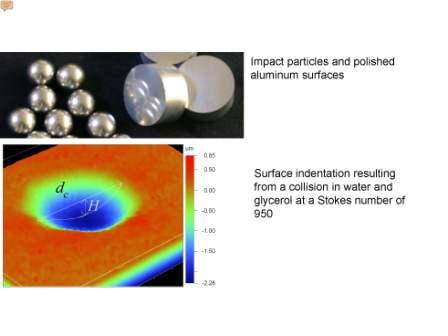
Measurements are also being undertaken on surface deformation and erosion during impact in a viscous fluid. Both normal and oblique collisions will be examined for different Stokes numbers and material properties. |
 |
Simulations of Collisions in a Liquid
We are interested in developing computational methods to compute flows in which particle interactions and the inertia of both the liquid and solid phases are important. To calculate the flow field, we have been using the immersed boundary method is used to simulate the process of a rigid sphere settling and colliding with a non-deforming solid wall. By including a contact model, the numerical method captures the elasticity of the solid boundaries and mitigates the resolution problem when the particle is close to the wall. The axisymmetric numerical method has been validated through comparisons with experimental measurements of particle collisions. We are interested in developing a three-dimensional code that models the collision process and can include many particles.
TOP
|
| Granular Flows
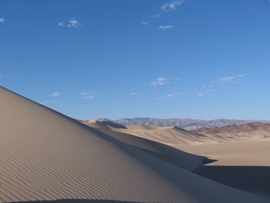
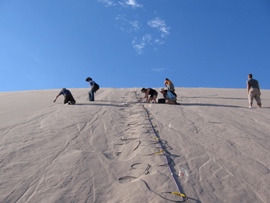
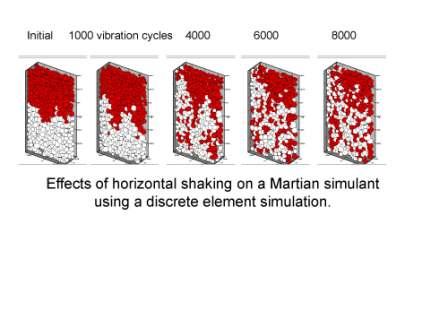
Granular flows occur in industry (for example: dry chemicals, pharmaceutical powders, plastic pellets, toner), agriculture (grains, food products), natural environments (sand and debris flows), and in lunar and Martian exploration. Dry flows of these materials are governed by the particle collisions, and the interstitial fluid has negligible effect on the momentum transport. These flows are often modeled analytically by exploiting ideas from dense-gas kinetic theory, and through discrete particle simulations. In addition, discrete element simulations are used to compute dry flows by modeling the inelasticity and friction of the particles, and computing the motion by integrating Newton 's equation.
We have been interested in mixing and segregation of granular materials, the effects of vibration, wave propagation, heat and mass transfer within the materials, and a variety of related processes involving these complex materials.
TOP |
Select Recent Publications
F.L. Yang & M.L. Hunt, Dynamics of Particle-Particle Collisions in a Viscous Liquid, Physics of Fluids, 18, 12, 121506 (2006).
N.M. Vriend, M.L. Hunt, R.W. Clayton, C.E. Brennen, K.S. Brantley, A. Ruiz-Angulo, Solving the Mystery of Booming Sand Dunes, Geophysical Research Letters, 34, L16306, doi: 10.1029/2007GLO30276. Further reproduction or electronic distribution is not permitted. (2007).
N.M. Vriend, M.L. Hunt, R.W. Clayton, C.E. Brennen, K.S. Brantley, A. Ruiz-Angulo, Reply to Solving the Mystery of Booming Sand Dunes, Geophysical Research Letters, 35, L08307, doi: 10.1029/2008GLO33202. Further reproduction or electronic distribution is not permitted. (2008). F.L. Yang & M.L. Hunt, A Mixed Contact Model for an Immersed Collision between Two Solid Surfaces, Philosophical Transactions of the Royal Society a-Mathematical Physical and Engineering Sciences, 366, 1873, 2205-2218 (2008).
M.L. Hunt & N.M. Vriend, Booming Sand Dunes, Annual Review of Earth and Planetary Sciences, 38,
pp. 281-301 (2010).
A. Ruiz-Angulo & M.L. Hunt, Measurements of the Coefficient of Restitution for Particle Collisions with Ductile Surfaces in a Liquid, Granular Matter , vol 12, pp. 185-191 (2010).
X. Li, M.L. Hunt & T. Colonius, A Contact Model for Normal Immersed Collisions between a Particle and a Wall, to appear J. Fluid Mechanics (2011).
N.M. Vriend, M.L. Hunt, R. W. Clayton, Stratigraphy of Large Sand Dunes: Examples from Dumont and Eureka Dunes, submitted (2011).
N.M. Vriend, M.L. Hunt, R. W. Clayton, Linear and Nonlinear Wave Propagation in Booming Sand Dunes, submitted (2011).
TOP
|
Courses
ME 18, Thermodynamics
9 units (3-0-6); second, third terms. Prerequisites: Ph1 and Ph2 (may be taken concurrently). An introduction to classical thermodynamics with engineering applications. First term includes the first and second laws; closed and open systems; properties of a pure substance; availability and irreversibility; generalized thermodynamic relations. Second term emphasizes applications: gas and vapor power cycles; propulsion; mixtures; combustion and thermochemistry; chemical equilibrium. ME 72, Engineering Design Laboratory
9 units (3-4-2); first term; (1-8-0), second term. Prerequisites: ME 35 abc, ME 71, ME 18 ab, CS 1, or equivalent and instructor's permission. Enrollment is limited. A project based course in which teams of students design, fabricate, analyze, test, and operate an electromechanical device to compete against devices designed by other student teams. The class lectures and the projects will stress the integration of mechanical design, sensing, engineering analysis, and computation to solve problems in engineering system design. The laboratory units of ME 72 can be used to fulfill a portion of the laboratory requirement for the ME or E&AS option. Not offered on a pass/fail basis.
ME 75, Introduction to Multidisciplinary Systems Engineering
3 units (2-0-1) , 6 units (2-0-4), or 9 units (2-0-7) first term; 6 units (2-3-1), 9 units (2-6-1), or 12 units (2-9-1) second term; 12 units (2-9-1), 15 units (2-12-1), or 18 units (2-15-1), with instructor's permission, third term. This course presents the fundamentals of modern multidisciplinary systems engineering in the context of a substantial design project. Students from a variety of disciplines will conceive, design, implement, and operate a system involving electrical, information, and mechanical engineering components. Specific tools will be provided for setting project goals and objectives, managing interfaces between component subsystems, working in design teams, and tracking progress against tasks. Students will be expected to apply knowledge from other courses at Caltech in designing and implementing specific subsystems. During the first two terms of the course, students will attend project meetings and learn some basic tools for project design, while taking courses in CS, EE, and ME that are related to the course project. During the third term, the entire team will build, document, and demonstrate the course design project, which will differ from year to year. Freshmen must receive permission from the lead instructor to enroll.
ME 90, Senior Thesis, Experimental
9 units; (0-0-9) first term; (0-9-0) second, third terms. Prerequisite: senior status; instructor's permission. Experimental research supervised by an engineering faculty member. The topic selection is determined by the adviser and the student and is subject to approval by the Mechanical Engineering Undergraduate Committee. First and second terms: midterm progress report and oral presentation during finals week. Third term: completion of thesis and final presentation. The second and third terms may be used to fulfill laboratory credit for EAS. Not offered on a pass/fail basis.
ME 91, Senior Thesis, Analytical
9 units (0-0-9); first, second, third terms. Prerequisite: senior status; instructor's permission. Undergraduate research supervised by an engineering faculty member. The topic selection is determined by the adviser and the student and is subject to approval by the Mechanical Engineering Undergraduate Committee. First and second terms: midterm progress report and oral presentation during finals week. Third term: completion of thesis and final presentation. Not offered on a pass/fail basis.
ME 118, Thermodynamics
9 units (3-0-6); first term. Prerequisites: ME 18ab, ME 19ab. Fundamentals of classical and statistical thermodynamics. Basic postulates, thermodynamic potentials, chemical and phase equilibrium, phase transitions, and thermodynamic properties of solids, liquids and gases.
ME 119, Heat and Mass Transfer
9 units (3-0-6); second, third terms. Prerequisites: ME 18ab, ME 19ab, ACM 95/100 (may be taken concurrently). Transport properties, conservation equations, conduction heat transfer, convective heat and mass transport in laminar and turbulent flows, phase change processes, thermal radiation.
TOP
|
|
Former Graduate Students
Xiaobai Li (2010)
Postdoctoral Scholar, Robert Bosch LLC
Research and Technology Center, Palo Alto, CA
Thesis:
Experimental and Numerical Study of Normal Particle-Wall Collisions in Liquid-Solid Flow
Nathalie Vriend (2010)
Postdoctoral Research Associate, University of Cambridge , Cambridge , UK
Department of Applied Mathematics and Theoretical Physics
http://www.damtp.cam.ac.uk/people/n.m.vriend/
n.m.vriend@damtp.cam.ac.uk
Thesis: Booming Sand Dunes
Erin Koos (2009)
Postdoctoral Scholar,
University of Karlsruhe, Germany
Applied Mechanics Group
Erin.Koos@mvm.uni-karlsrhue.de
Thesis: Rheological measurements in liquid-solid flows
Angel Ruiz-Angulo (2007)
Universidad Nacional Autónoma de México, México
Instituto de Investigaciones en Materiales
Thesis: Surface Deformation in a Liquid Environment Resulting from Single Particle Collisions Fu-Ling Yang (2006)
Assistant Professor,
National Taiwan University, Taiwan
Department of Mechanical Engineering
FuLingYang@ntu.edu.tw
Thesis: Interaction Law for a Collision Between Two Solid Particles in a Viscous Liquid
Gustavo Joseph (2003)
Senior Thermal Modeling Engineer, Tessera Technologies
http://www.tessera.com/Pages/tessera.aspx
Thesis: Collisional Dynamics of Macroscopic Particles in a Viscous Fluid
Anna Karion (2000)
Research Scientist, NOAA & Univ. of Colorado
karion@breadboard.com
Thesis: Couette Flows of Granular Materials: Mixing, Rheology, and Energy Dissipation
Lucky Benedict (1999)
Thesis: Buoyant Flows in Vertical Channels Relating to Smoke Movement in High-Rise Building Fires
Roberto Zenit (1998)
Professor, National Autonomous University of Mexico
zenit@servidor.unam.mx
http://mecmat.iimatercu.unam.mx/~zenit/
Thesis: Collisional Mechanics in Solid-Liquid Flows
Carl Wassgren (1997)
Associate Professor of Mechanical Engineering and Industrial and Physical Pharmacy (by courtesy), Purdue University
wassgren@purdue.edu
http://meweb.ecn.purdue.edu/~wassgren/
Thesis: Vibration of Granular Materials
Venkata Natarajan (1997)
IT Director for Strategic Projects, Ing Advisors Network, Georgia
Thesis: Material and Thermal Transport in Vertical Granular Flows
Rajesh Kedia (1997)
Citadel Investment Group LLC, Security/commodity services, Chicago
Thesis: An Investigation of Velocity and Temperature Fields in Taylor-Couette Flows
Angela Shih (1994)
Associate Professor, Cal Poly Pomona
ACShih1@CSUPomona.edu
http://www.csupomona.edu/%7Eme/shih.htm
Thesis: The Study of Taylor-Couette Flows with Superimposed Isothermal and Heated Axial Flows at High Taylor Numbers
Khalid Juhany (1994)
Chairman Aeronautical Engineering, King Abdulaziz University, Saudi Arabia
http://engg.kaau.edu.sa/aero/contactus.htm
Thesis: Supersonic Film Cooling Including the Effect of Shock Wave Interaction
Shu-San Hsiau (1993)
Professor, National Central University, Taiwan
sshsiau@cc.ncu.edu.tw
http://www.me.ncu.edu.tw/Faculty.htm
http://www.me.ncu.edu.tw/granflow/lab.htm
Thesis: Shear-Induced Transport Properties of Granular Material Flows |